Home / Blog / SBF & the Kimchi Premium
Arbitrage · Crypto historyHow SBF Got Rich Before FTX: the Kimchi Premium Arbitrage, Explained
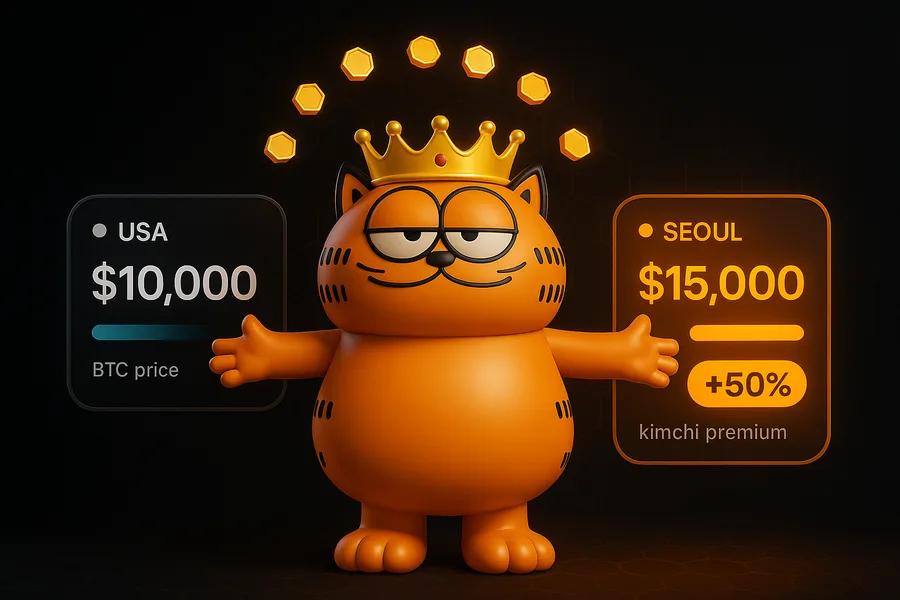
In January 2018, the same bitcoin had two prices: around $15,000 on US exchanges — and up to 50% more in Seoul. Before FTX, before the fraud conviction, Sam Bankman-Fried got rich on exactly that gap: the most famous arbitrage in crypto history. Here's how the trade actually worked, why the "free money" was brutally hard to collect, and what's honestly left of cross-exchange arbitrage in 2026.
This story has two separate chapters, and we tell both. The arbitrage described here (2017–2018) was legal, clever trading. Years later, in November 2023, SBF was convicted of fraud over FTX's misuse of customer funds — a different chapter, covered honestly below. Nothing in this article is financial advice, no result is typical or guaranteed, and no, you can't replicate 50% spreads today. We explain why.
The Jane Street kid with a plan
Before the billions, Sam Bankman-Fried was a trader at Jane Street Capital, one of the world's largest quantitative trading firms. His desk arbitraged international ETFs: buy a basket of assets in one market, sell its equivalent in another, capture tiny discrepancies — at enormous scale, all day long. It's the least glamorous job in finance, and it turned out to be the perfect training for what came next.
In late 2017 he quit, and in November 2017 he founded Alameda Research in Berkeley, California, with a small crew of traders recruited from the effective-altruism community. The starting capital wasn't a venture round — it was borrowed money, some of it reportedly at interest rates approaching 50% a year, lent by wealthy effective altruists who trusted the team. Capital that expensive only makes sense if you know a trade that pays even more.
Alameda believed it did. Because in the winter of 2017–2018, crypto prices had stopped agreeing with each other.
The kimchi premium: one coin, two prices
During the 2017 bull run, South Korean retail demand for crypto went vertical — and Korean exchange prices detached from the rest of the planet. The gap earned a name: the kimchi premium.
- Between January 2016 and February 2018, the premium averaged about 4.7% (as measured in the academic study that formalized it).
- In early January 2018 it peaked around 54%: bitcoin near $15,000 on US exchanges was trading around $23,000 in Seoul.
- It distorted the whole market's picture of itself: on January 8, 2018, CoinMarketCap removed Korean exchanges from its average price without warning — and the global "price of bitcoin" appeared to crash overnight.
The arbitrage textbook says: buy where it's cheap, sell where it's expensive, pocket the difference as prices converge. The kimchi premium was that textbook drawn in neon, visible on every screen on Earth. And yet it sat there for months at double-digit width — which should be impossible. Free money doesn't wait around. Unless, of course, it isn't free.
Why the "free money" was so hard to collect
To capture the premium you have to close a full loop: (1) buy bitcoin with dollars, (2) send it to a Korean exchange, (3) sell it for won, (4) convert the won back into dollars and get them out of the country. Steps 1–3 were easy. Step 4 was a wall:
- Capital controls. The Korean won is not freely convertible offshore. Moving meaningful amounts out of Korea requires documentation and justification, with tight yearly thresholds for individuals — the loop couldn't legally close at size.
- Real-name banking. Korean exchanges required accounts linked to Korean real-name bank accounts, effectively locking out foreigners.
- Transfer risk. While your bitcoin was in flight between exchanges, the price could move violently — January 2018 saw double-digit daily swings. The spread could vanish, or invert, mid-transfer.
- Banks themselves. Withdrawal caps, compliance reviews and frozen wires: a bank seeing large, repeated international transfers linked to crypto in 2018 usually reacted by slamming the door.
That's the resolution of the paradox: everyone could see the number; almost nobody could touch it. By SBF's own later accounts, Alameda only ever ran a modest amount through Korea, through convoluted but legal structures — nowhere near the size the spread invited. The real trade was next door.
The trade Alameda actually ran: Japan
Japan had its own bitcoin premium — smaller, around 10% (at moments closer to 15%) — but with one decisive difference: the yen is freely convertible. The loop could actually close. Buy bitcoin in the US, send it to a Japanese exchange, sell it for yen, convert to dollars, wire them home, repeat.
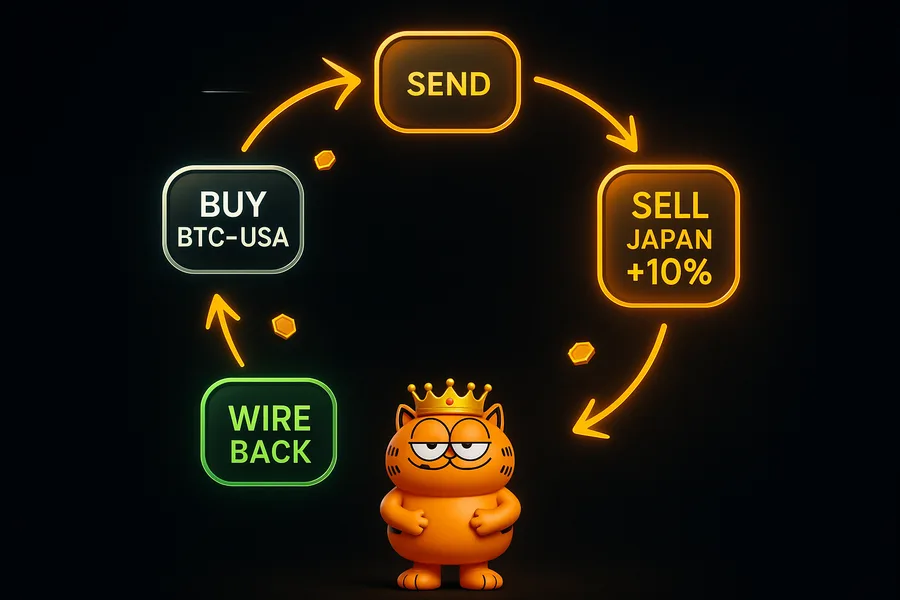
The hard part wasn't code, and it wasn't the idea. It was banking: a Japanese entity to hold exchange accounts, banks on both sides willing to process large international wires every single day, and people physically showing up to keep the pipeline unclogged. Michael Lewis's account of the period, Going Infinite, describes the loop moving up to $25 million a day at its peak. In the few weeks the window stayed open, the trade reportedly netted Alameda around $20 million — before premiums collapsed with the broader market in early February 2018.
Note carefully where the edge lived. Not in seeing the spread — the whole world saw it. Not in a secret signal. The edge was operations: entities, bank relationships, exchange accounts, wire schedules, and the willingness to grind through paperwork at maximum speed while the window was open. The story is remembered as genius. Mostly, it was logistics, executed relentlessly.
What that trade really teaches
- A spread is a price for risk and friction. The 50% wasn't a gift: it was compensation for capital controls, settlement time, compliance risk and frozen wires. If you can't carry those risks, the spread was never yours.
- Seeing is nothing; executing is everything. The premium was public information for months. The scarce resource was a working pipeline, not the observation.
- Windows close fast. The Japan trade lasted weeks, not years. Arbitrage rewards the ready — the entity you set up before the spread appears is the one that earns during it.
- Expensive conviction has to be honest. Alameda paid up to ~50% interest on its capital. That only works if you size the trade to survive being wrong, and stop when the edge is gone.
The rest of the story — honestly
The arbitrage era made Alameda's name, and Alameda's profits built what came next: in 2019 SBF founded the FTX exchange. By 2021 it was valued at $32 billion, its logo was on a Miami arena and Super Bowl ads, and SBF — usually on a webcam, in a T-shirt — was the most recognizable face in crypto.
In November 2022, FTX collapsed in days. Customer deposits had been quietly funneled to Alameda and lost in illiquid bets and spending. In November 2023 a New York jury convicted SBF on all seven counts of fraud and conspiracy; in March 2024 he was sentenced to 25 years in prison with an $11 billion forfeiture order. His appeal was still working through the courts as of this writing.

Be precise about what failed, because the two chapters teach opposite lessons. The kimchi and Japan trades were legal arbitrage — the part of the story worth studying. What destroyed FTX was custody: millions of customers' funds sat where one company could reach them, and it did. That lesson is structural, and it's why OX-ENGINE is built non-custodial from the ground up — trade-only keys, withdrawals locked to the fund owner — so the operator physically can't do what FTX did.
Arbitrage in 2026 (and where bots fit)
The kimchi premium never fully died — Korean capital controls still exist, so the gap still breathes. It usually sits in the low single digits now, and it flared back toward 10% during the March 2024 bull surge. But the 50% windows are gone: banking rails matured, market makers globalized, and far more capital watches every venue.
Where cross-venue gaps actually live today: funding-rate spreads between perp venues, CEX–DEX dislocations during volatility spikes, thin new listings, and short-lived cross-DEX gaps. They're real, they're smaller, and they close in seconds to minutes — which makes screen-watching humans structurally too slow. This is bot territory, and it's exactly the class of inefficiency we built our signal engine to cross-reference in real time.
Our honest contribution to this story is detection, not magic: the OX-ENGINE Arbitrage Bot (@oxengine_arbitrage_bot) monitors spreads across venues around the clock and delivers opportunities to your Telegram the moment they open. It alerts — you decide. It never holds your funds, and it never promises profit, because 2018's real lesson is that a spread is a risk premium, not a coupon. SBF's edge was a banking pipeline; yours can be reaction time.
FAQ
What was the kimchi premium?
The persistent gap between bitcoin's price on South Korean exchanges and the rest of the world — Korean retail demand colliding with capital controls. It averaged about 4.7% from January 2016 to February 2018 and peaked around 54% in early January 2018.
How much did SBF actually make from the arbitrage?
Korea could only be done in small size. The industrial trade was Japan's ~10% premium: reported accounts describe up to $25 million a day moving through the loop and roughly $20 million of profit in a few weeks. Reported, not audited — treat the exact figures with care.
Does the kimchi premium still exist?
Yes — usually low single digits, occasionally near 10% in strong bull runs (as in March 2024). The structural causes, capital controls and real-name banking, are still in place; the extreme 2018 widths are not.
Is crypto arbitrage still profitable in 2026?
Gaps exist — funding spreads, CEX–DEX dislocations, listings — but they're smaller, faster and heavily bot-competed, and fees plus transfer risk eat naive attempts. Nothing is guaranteed. The realistic role of automation for an individual is 24/7 detection and instant alerts, which is what our arbitrage bot does.